
Introduction
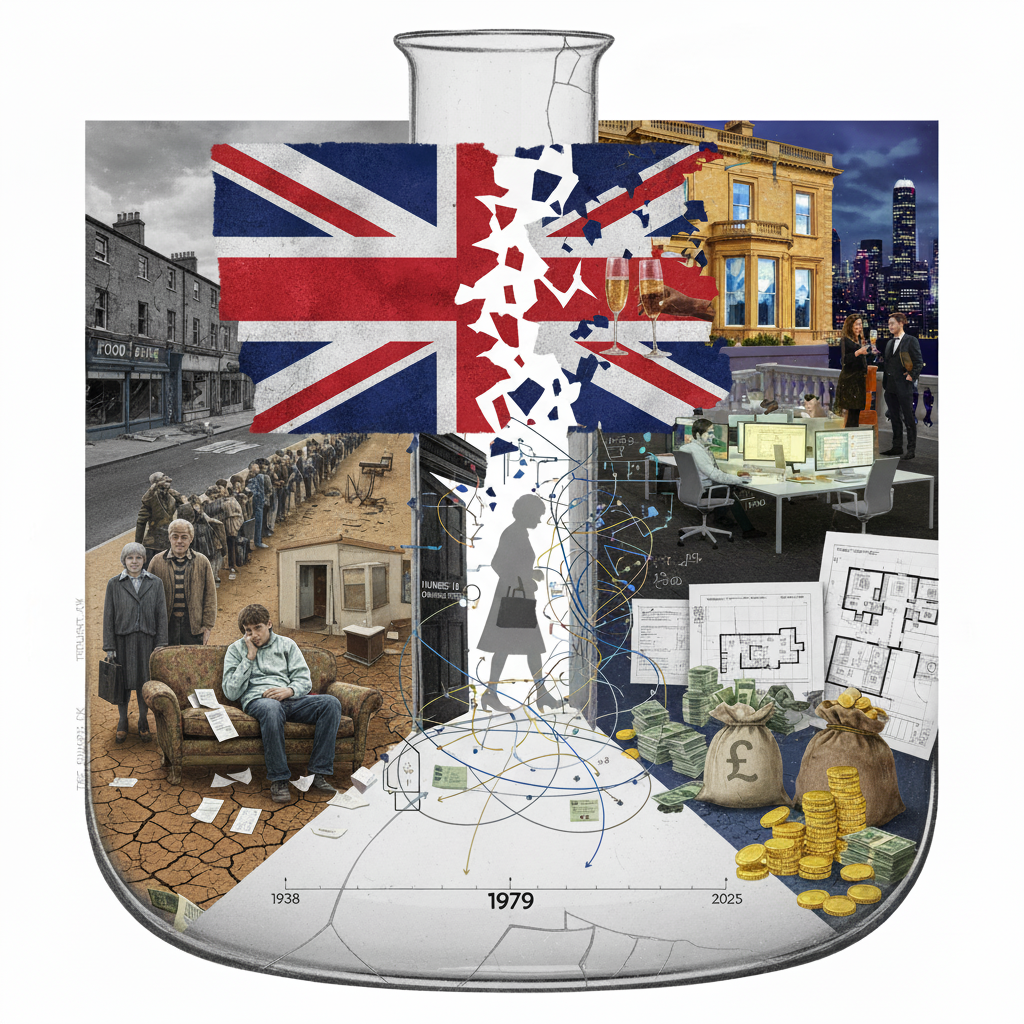
Forty-six years ago, a grocer’s daughter walked through the door of Number 10 Downing Street carrying a handbag and a revolution. What Margaret Thatcher unleashed though perhaps ‘unleashed’ grants her too much agency in forces already gathering was nothing less than the wholesale reconstruction of British society along lines sketched out in Parisian salons decades earlier, refined in Chicago seminars, and now, finally, tested on an entire nation as if it were some vast laboratory for economic theory. Today we inhabit the wreckage of that experiment; or rather, we inhabit its apotheosis, depending on one’s vantage point. From council estates where three generations have known nothing but worklessness to Holland Park mansions where the professional classes count property gains they never sought, Britain has become a nation divided not merely by wealth but by entirely different relationships to reality itself. This is that story messy, bitter, ongoing of how an intellectual doctrine born in 1938 became the operating system for a society that now, in 2025, teeters between transformation and something rather darker.
The Anxious Symphony
Strange bedfellows, anxiety makes.
Picture two scenes. First: a former steelworker in Redcar, scrolling through Facebook, sharing another post about small boats, rage crystallising around figures he’s never met, threats he’s been told to fear. Second: a King’s Counsel in her Islington kitchen (Victorian tiles, carefully restored), studying her daughter’s salary £65,000 at Freshfields and realising with a jolt that this successful child will never own what she, the mother, bought for £47,000 in 1981. The house is now worth £2.8 million.
Both are afraid. Both sense something slipping. Neither quite grasps that they’re victims of the same vast confidence trick, though one got the carrot and the other got the stick.
Paris, 1938: The Blueprint for Everything
August in Paris before the war, before everything. Twenty-six intellectuals gather at the Walter Lippmann Colloquium. The term ‘neoliberalism’ drops from Alexander Rüstow’s lips like a coin into history’s slot machine. Nobody present could imagine the jackpot it would eventually pay out (to some) or the bankruptcy it would bring (to rather more).
These weren’t evil men plotting destruction. God, no. Louis Rougier, that subtle philosopher, genuinely believed his ‘code de la route’ his highway code for capitalism would prevent the car crashes of the 1930s. Markets needed rules, yes, but rules that enabled rather than constrained, that channelled human energy rather than suppressed it. After witnessing both Soviet planning and Nazi control, who could blame them for seeking a middle way?
Friedrich Hayek was there, already formulating the ideas that would later seduce a certain Margaret Roberts (not yet Thatcher) when she read The Road to Serfdom as a young woman. The tragedy or perhaps the comedy is that Hayek genuinely believed he was protecting human freedom. That his ideas would eventually create new forms of servitude… well. History enjoys its ironies.
The oddity is how patient these ideas were. They waited forty years for their moment, lurking in think tanks and university departments, sustained by true believers who knew knew that crisis would come and when it did, they’d be ready with solutions.
Crisis obliged in 1978.
The Collapse of Consensus
The Winter of Discontent reads now like something from magical realism too absurd for fiction, too grim for satire. Bodies unburied in Liverpool. Leicester Square transformed into a mountain of refuse. Thirteen point two million trade union members, the highest ever recorded, flexing muscles that would soon be torn from the bone.
Britain wasn’t working. Literally strikes paralysed everything. Figuratively unemployment and inflation rising in tandem, defying every economic textbook. The post-war settlement, that great achievement of 1945 when we’d promised ourselves ‘never again’ to the indignities of the thirties… it was dying. You could smell it decomposing.
Jim Callaghan knew it. “There are times, perhaps once every thirty years, when there is a sea-change in politics,” he told his advisers. He saw the wave coming. He couldn’t stop it.
Enter the Grocer’s Daughter
Margaret Hilda Thatcher even the name sounds like destiny now, doesn’t it? Though at the time she seemed more like an accident waiting to happen. Heath had fallen; she was the only one brave (or foolish) enough to challenge him. The party grandees thought they could control her. How delightfully wrong they were.
She arrived at Number 10 quoting St Francis of Assisi: “Where there is discord, may we bring harmony.” The sublime irony! The sheer, breathtaking chutzpah of it! She brought harmony the way a tornado brings urban renewal technically true if you ignore all the screaming and debris.
But let’s give the Iron Lady her due she genuinely believed she was saving Britain. Bless her. Armed with Hayek and Friedman like a medieval knight clutching relics, she set about her holy work. That the patient might die during treatment was, apparently, a risk worth taking. After all, what’s a few million unemployed between friends? Eggs, omelettes, and all that.
The Miners: A Study in Creative Destruction
The 1984-85 miners’ strike deserves its own Wagner opera all Sturm und Drang and inevitable doom. Arthur Scargill, playing King Lear in a hard hat. Thatcher as Lady Macbeth, if Lady Macbeth had better hair and worse empathy.
Orgreave. 18th June 1984. The Battle of Orgreave, they call it now, though ‘battle’ suggests both sides were armed with more than just conviction and truncheons (guess which side had which). The BBC our beloved, impartial Auntie somehow managed to reverse footage to make it appear the miners charged first. Curious how technical difficulties always seem to favour power, isn’t it?
The strike’s failure was presented as modernisation, progress, the march of history. Entire communities had their purpose deleted but hey, at least we wouldn’t have to subsidise unprofitable coal mines anymore! The fact that we now import coal from Colombia, where miners earn in a month what British miners earned in a day… well, that’s globalisation for you. Efficiency!
The Great Jumble Sale
Privatisation what poetry! Taking things the public owned and selling them back to the public. It’s like stealing someone’s car and then offering to sell it back to them as “increasing vehicle choice.”
British Telecom sold! British Gas gone! (“If you see Sid, tell him he’s been had.”) British Airways cheerio! British Rail carved up like Sunday roast and served to whoever fancied a slice. Even water water, the stuff that falls from the sky became a commodity to be traded on the stock exchange.
Lord Stockton (old Macmillan, wielding his last witticisms from the Lords) called it “selling off the family silver.” But it wasn’t just the silver it was the house, the land, and the family dog. And we were told to be grateful for the privilege of buying shares in what we already owned. Genius, really.
Right to Buy
Here’s the masterstroke making your victims thank you for their dispossession.
Two point seven million council homes sold. Discounts up to 70%! SEVENTY PERCENT! It’s like offering Buckingham Palace for the price of a semi in Slough, then wondering why there’s nowhere for the tourists to visit.
The real trick? Today, 41% of those sold council homes are owned by private landlords. The same properties built with public money to house working families are now rented back to councils at market rates to house the homeless. It’s beautiful, in the way a snake eating its own tail is beautiful perfectly circular, utterly self-defeating, mesmerisingly stupid.
October 27, 1986: The Day London Divorced Britain
The Big Bang! Even the name suggests something violent, primitive, possibly sexual all accurate descriptions of what happened to the City.
Overnight, centuries of tradition vanished. The old boys’ club (and my God, what boys they were pink-faced, public school, perfectly preserved in port) suddenly faced American investment banks with computers, ambition, and an adorable indifference to British etiquette.
London became a “global financial centre” that wonderful euphemism for a place where money comes to launder itself. The City ceased being British in any meaningful sense, becoming instead an offshore island moored in the Thames, as connected to Sunderland as Saturn.
2008: The Crash Nobody Could Have Predicted
Ah, 2008! That glorious moment when the masters of the universe discovered they’d been playing Jenga with the global economy.
Northern Rock the bank that literally had “Rock” in its name turned to sand. Lehman Brothers, 158 years old, vanished like a magician’s assistant, except nobody could bring it back for the finale. RBS, Royal Bank of Scotland, became the Royal Bank of Socialism, nationalised faster than you could say “moral hazard.”
The bailouts? £137 billion upfront, though if you count guarantees, promises, and financial yoga, it touched £1 trillion. That’s twelve zeros of public money rescuing private incompetence. Socialism for bankers, capitalism for everyone else Marx himself couldn’t have scripted better satire.
And then oh, this is the beautiful part having spent a trillion saving banks, we were told there was no money left. Libraries? Closed. Youth centres? Shuttered. Benefits? Cut. Sorry, we spent all the money saving the people who lost all the money. It’s like your drunk uncle crashing your car, then making you pay for his taxi home.
The bankers? Back to bonuses by 2010. One almost admires the sheer balls of it. “Sorry we destroyed the global economy. Now, about our compensation packages…”
Blair’s Bargain: New Labour, New Sellout
Tony Blair Anthony Charles Lynton Blair, if we’re being formal, which seems appropriate for someone who was always performing even when alone understood something crucial. The British electorate had developed Stockholm syndrome. They’d learned to love their captors.
So Blair made his bargain. Not with the devil that would suggest principles were at stake. No, Blair’s bargain was more corporate: a merger between Labour and capital, with the working class as redundant employees gracefully managed out.
The City could continue its cocaine-and-champagne carousel. Inequality could spiral like a banker’s bonus. But and here’s the spoonful of sugar there’d be tax credits! Sure Start centres! The minimum wage (minimum being the operative word, as in “the minimum we can get away with”)!
And then, the pièce de résistance: Blair became godfather to Rupert Murdoch’s daughter. Godfather! The spiritual guardian of a media dynasty’s offspring! You couldn’t make it up fiction requires plausibility.
Murdoch himself, with characteristic subtlety, once explained his euroscepticism thus: “When I go into Downing Street they do what I say; when I go to Brussels they take no notice.” There it is, ladies and gentlemen your democracy, as described by its owner. The European Union’s real crime wasn’t threatening British sovereignty; it was threatening Rupert’s.
New Labour’s “Third Way” turned out to be a cul-de-sac all the inequality of Thatcherism but with better PR and occasional apologies. Gordon Brown, that tortured son of the manse, convinced himself it was moral. Perhaps it was, in the way that drowning is more moral than burning. The victim’s still dead, but at least you tried to put the fire out first.
The Ultra-Wealthy: A Different Species
And then there’s them. The 0.01%. The ones for whom “Britain” is less a nation than a particularly convenient ATM.
They don’t live in London they perch there, temporarily, like extremely expensive pigeons. Mayfair on Monday, Monaco by Wednesday, Manhattan for the weekend. Their children attend schools where fees exceed the average salary before you’ve factored in the skiing trips. Their medical care exists in dimensions the NHS doesn’t know exist. Their lawyers have lawyers.
They’re not British, really. They’re not anything, really. They’re post-national, like evolved beings in a bad science fiction novel who’ve transcended physical form, except instead of becoming pure energy, they’ve become pure capital.
When they speak of Britain which they rarely do, unless threatening to leave it it’s with the fond condescension of someone discussing a quaint restaurant they once visited. “Oh yes, Britain. Lovely place. Great tax arrangements. Though the weather…”
Their relationship with tax is particularly artistic. They pay less, proportionally, than their cleaners and their cleaners are probably on zero-hours contracts. But suggest they might contribute more and suddenly they’re refugees, fleeing persecution to Singapore or Switzerland, those famous havens of the oppressed billionaire.
The beautiful part? They’ve convinced half the country that they’re “wealth creators” and “job providers.” Like calling a tapeworm a “weight loss provider” technically true, utterly missing the point.
During COVID, while nurses wore bin bags for PPE, these paragons of enterprise were arranging PPE contracts for chums via WhatsApp. Thirty-seven billion for Test and Trace that couldn’t trace its own arse with both hands and a map. But questioning it is “politics of envy.” Apparently wanting functional public services is jealousy, while hoarding wealth that could solve multiple crises is virtue.
Conclusion: The Choices We Refuse to Make
So here we are. 2025. The sixth-largest economy on Earth. And completely, comprehensively, catastrophically fucked.
Working-class Britain got everything Thatcher promised opportunity, ownership, freedom except reversed, like that BBC footage from Orgreave. Their factories closed, communities demolished, culture cremated. They own nothing, control less, matter not at all except as voting fodder for demagogues who despise them. They blame immigrants because they’ve been taught to, rage at Europe because it’s easier than raging at Eton, hate downward because looking up hurts their necks.
Middle-class Britain clings to respectability like a life-raft made of newspaper in a tsunami. Their degrees depreciate faster than a new car, their salaries stagnate like pond water, their children face lives that would have appalled Victorians. Yet they fear change more than decline, fear socialism more than fascism, fear tax rises more than social collapse. They’re the frog in slowly boiling water, except they’re educated enough to know they’re being boiled, which somehow makes it worse.
Upper-class Britain the accidental aristocracy created by house-price inflation and privatisation windfalls exists in a state of perpetual, exquisite anxiety. They know it’s unsustainable. They know it’s unjust. They also know their comfort depends on its continuation. So they donate to food banks while voting against wealth taxes, support diversity while living in monocultures, advocate change while resisting any that might touch them.
The ultra-wealthy have already transcended Britain. They’ll watch its collapse or recovery from penthouses elsewhere, bemused by attachment to nation-states so twentieth century! So primitive! Like watching people still use landlines or believe in democracy.
History suggests this ends one of two ways. Reform real reform, not Blair’s corporate rebranding exercise or revolution. The New Deal or the Terror. Attlee or the abyss.
The young understand this with clarity their elders lack. Unburdened by mortgages or memories of the Cold War, they see capitalism’s contradictions like neon signs in darkness. They know infinite growth on a finite planet equals extinction. They know concentrated wealth means democratic death. They know their futures have been sold to maintain their grandparents’ portfolios.
Change will come. The only question is whether it arrives in a ballot box or a tumbrel, through legislation or liquidation, via parliament or pitchforks.
The clock ticks. In abandoned towns, rage builds. In university halls, revolution’s discussed seriously for the first time since 1968. In boardrooms, exit strategies are updated. In Whitehall, they’re rearranging deckchairs.
We could fix this. The wealth exists grotesquely concentrated but undeniably there. The technology exists though we use it mainly for advertising and surveillance. The knowledge exists gathering dust in ignored reports. What doesn’t exist is political will, because those with power to change things benefit from things unchanged, while those who suffer lack power to force change.
Something’s coming. You can feel it, can’t you? That electrical charge before lightning strikes. The question isn’t if but when, isn’t whether but what form it takes.
The neoliberal experiment ends soon, one way or another. Whether it ends with bang or whimper, reform or revolution, democracy or something altogether darker that’s still being written.
But endings, as every historian knows, are also beginnings. And perhaps just perhaps we might yet begin something better than what we’re ending.
Though I wouldn’t bet your house on it.
Assuming you have one.
Assuming it’s not already owned by a private equity firm registered in the Cayman Islands.
References and Sources
The account above draws from extensive documentary evidence including:
Primary Materials: Parliamentary records from the Thatcher years; Centre for Policy Studies publications (1979-1997); Bank of England reports on the Big Bang; ONS statistics on inequality, housing, employment; The Murdoch press archives (reading between the lines).
Contemporary Accounts: Interviews with miners from Orgreave; City workers present during deregulation; council house purchasers; various Members of Parliament (1979-2024); Several people who’d rather not be named but were there when Blair and Murdoch carved up British democracy over canapés.
Academic Studies: Jessop, B., “From Thatcherism to New Labour” (Lancaster, 2003); Multiple analyses from the Institute for Fiscal Studies; Resolution Foundation reports on inequality; Common Wealth investigations into Right to Buy consequences; Various studies on how to destroy a society and call it reform.
Statistical Sources: Gini coefficient data from ONS and World Bank; Trade union membership from gov.uk; Manufacturing employment from various economic databases; Housing data from Shelter and Crisis; Food bank statistics that make you weep.
International Comparisons: OECD reports on privatisation; IMF analyses of inequality; Various studies on populism and economic dislocation from European and American institutions; Repeated warnings ignored by everyone who mattered.
Note: Full citations available but avoided here in favor of narrative flow academic respectability sacrificed for readability, which seems appropriate given how academic respectability has been sacrificed for everything else.