
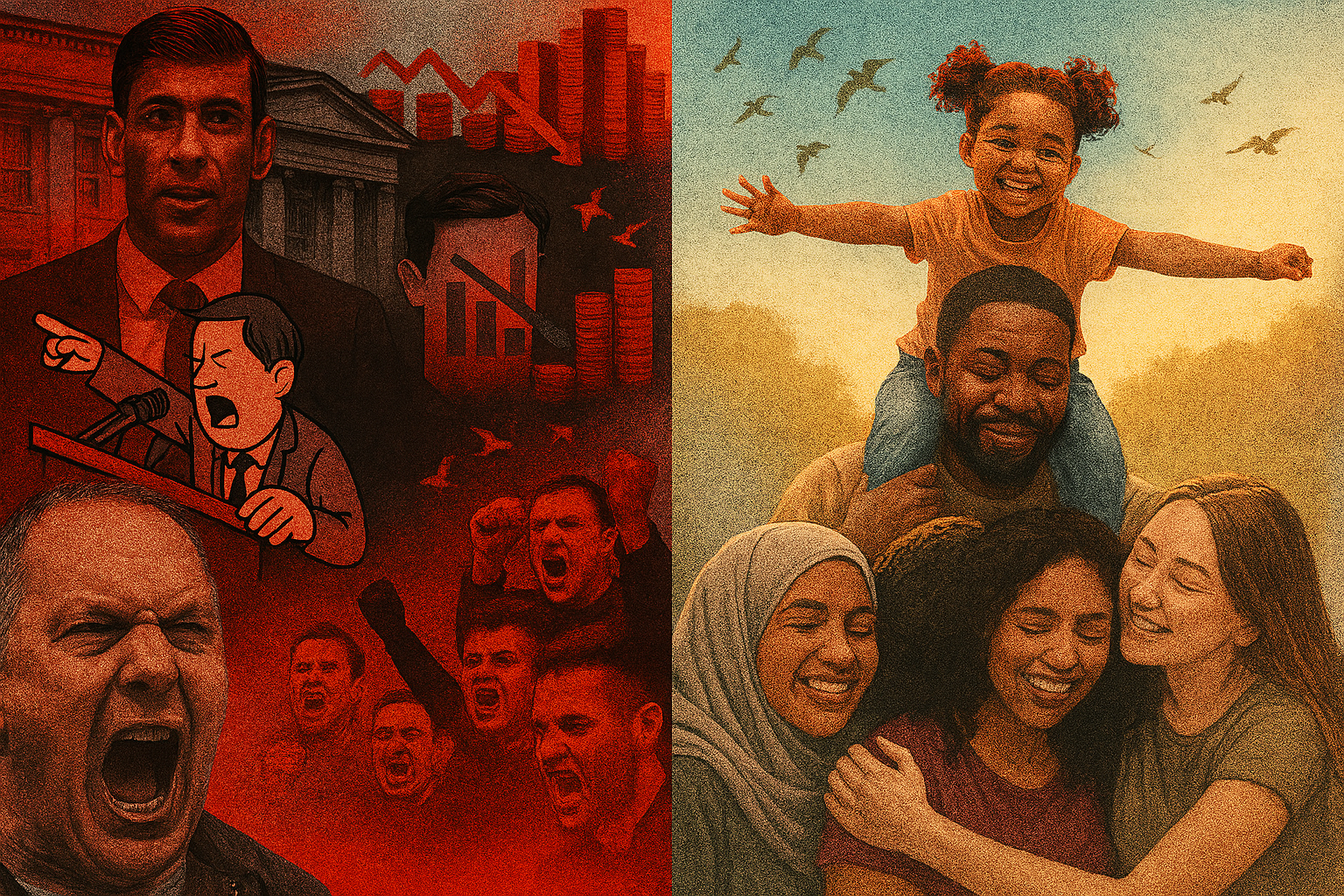
Britain is ailing. A creeping malaise, a poison, has seeped into the very foundations of our society, making the air thick with prejudice and division. We see it in the casual bigotry, the open hostility, the sickening chants outside hotels. This isn’t some phantom menace; it’s a tangible, corrosive force, and its architects are not hiding in the shadows any longer. They stand in plain sight, emboldened. To pretend otherwise is an act of wilful blindness, a dereliction of duty. We are witnessing a dangerous synergy: failing public institutions that harbour and protect prejudice, a political class that uses inflammatory rhetoric for strategic gain, severe economic inequality that leaves communities searching for scapegoats, and a fractured social and digital landscape that promotes division over solidarity. This is not merely a rise in individual acts of racism; it is a systemic crisis, a confluence of failures that demands our urgent, unsparing attention. Anything less would be a betrayal of the very idea of a fair and decent society.
Let’s be absolutely clear from the outset: the notion of ‘a few bad apples’ in our institutions is a tired cliché, a convenient lie that simply won’t wash anymore. The evidence, stark and undeniable, points to something far more insidious. Take the Metropolitan Police, for instance. Undercover investigations at Charing Cross police station—an institution meant to uphold law and order, to protect *all* citizens—exposed a culture where racist and misogynistic behaviour wasn’t just present, it was openly tolerated, even protected. Officers were caught on tape advocating violence and deportation against Muslims, describing Somali people as ‘scum’, and openly expressing support for far-right figures like Tommy Robinson. This isn’t an isolated incident; it’s a symptom, a screaming siren of a deep, systemic cultural problem. Former high-ranking officer Neil Bassu didn’t mince words: this behaviour wasn’t happening in secret. It was enabled by direct supervisors, a breakdown in the chain of command, a complete absence of robust self-policing. The problem, Bassu insisted, is cultural, not individual. And yet, the Met Commissioner’s stubborn refusal to use the term ‘institutional racism’ — despite admitting to ‘deep systemic issues’ and a ‘toxic legacy’ — speaks volumes. It’s a dismissal of the lived experiences of minority communities, a fundamental obstacle to any meaningful change. This isn’t just a failure of leadership; it’s a failure of moral courage. When a critical state institution is so compromised, when it signals that such prejudice can fester within its ranks, what message does that send to the rest of society? It’s a tacit nod, a subtle permission slip for hatred to flourish elsewhere.
Because that institutional rot doesn’t exist in a vacuum, does it? It reflects, and crucially, *contributes to*, a broader political climate that actively emboldens such views. On-the-ground racism, particularly anti-immigrant sentiment, is not some spontaneous eruption. It is actively encouraged, legitimised even, by the rhetoric of mainstream and far-right political figures. This political discourse provides a perceived ‘cover’ for racist actors, normalising extreme views and giving individuals license to express prejudice and hostility openly. We’ve seen it play out in protests outside asylum hotels, where the views expressed are often a direct echo of the misinformation and inflammatory language used in Parliament and by prominent media personalities. Asylum seekers are baselessly labelled as criminals, as sexual predators. Their presence is framed as a threat to ‘British culture’ and the safety of women and children—a classic, disgusting far-right trope. The atmosphere grows so charged that it leads to explicit calls for violence against the hotels, against the people inside them. Samir Ali, an organiser with Stand Up To Racism, draws that line directly: when politicians spread misinformation or use dehumanising language, it’s interpreted as permission on the streets. It’s a chilling feedback loop. Even the legitimacy and ‘Britishness’ of non-white leaders is openly questioned. Remember that LBC caller, claiming to represent Tory party members, who challenged Rishi Sunak’s position on racial grounds? ‘85% of English people,’ he declared, ‘are white English people and they want to see a prime minister that reflects them.’ This is not political debate; this is outright racial nationalism, draped in the flag. This is the kind of rhetoric that figures like Nigel Farage have perfected over decades, poisoning the well of public discourse, making it acceptable to voice what was once considered beyond the pale. They plant the seeds, and then feign surprise when the weeds of hatred grow.
But wait—this isn’t *just* about bad leadership or cynical politicians. To fully grasp this resurgence of racism, we must look beyond surface-level prejudice to the underlying economic structures and anxieties that create a demand for scapegoats. This pattern, historically observed during times of crisis, sees cultural and racial tensions inflamed as a means of deflecting from the true sources of economic distress. The personal testimony of YouTuber JimmyTheGiant, a former alt-right follower, is illuminating. His journey began not with overt racism, but with a general anti-establishment sentiment, a feeling of being left behind. He found himself drawn to thinkers who offered explanations for societal decay that, at first, seemed separate from race. His critical turning point came from realising that many of the cultural conflicts central to right-wing discourse are often downstream from decades of economic policy—particularly the post-Thatcher neoliberal consensus that has systematically eroded living standards for many working-class people. What a revelation, that! That perhaps the anger isn’t *really* about immigrants, but about the disappearing jobs, the rising rents, the failing public services. There is a powerful argument, and frankly, a compelling one, that racism is often deliberately fostered by political and media elites to prevent class-based solidarity. By framing economic problems as a result of immigration or multiculturalism, attention is diverted from policies that benefit the wealthy at the expense of the working class, regardless of race. A young man interviewed in Bedford put it succinctly: ‘They’re trying to divide us. They don’t want us to unite because then we’ll realise who the real enemy is.’ Analyst Ash Sarkar explains how this was a deliberate narrative shift. Media elites, who once held the white working class in contempt for being ‘too close to black people,’ pivoted their narrative to one of racial grievance. It’s a cynical manipulation, a shell game designed to keep us fighting amongst ourselves while the real culprits count their profits.
These economic drivers are compounded by cultural and social dynamics that further fragment society and weaken collective action. Rising racism is also fuelled by social friction, including the weaponisation of identity politics and the tensions that arise in communities undergoing demographic change. This leads to feelings of exclusion and resentment on multiple sides, complicating the landscape of modern Britain and, at times, weakening the very movements designed to combat prejudice. Consider the curious urban versus rural divide in how racism is experienced. Professor Corin Fowler’s academic findings suggest that racism in the countryside is prevalent but subtle: feelings of being watched, stared at, children experiencing bullying. But then, Wilfred Emanuel-Jones, a black farmer living in rural Britain for 25 years, offers a counter-narrative. He argues that staring is simply how tight-knit rural communities treat *any* stranger, a sign of curiosity, not malice. He suggests that if you go looking for racism, you will find it. This isn’t to dismiss anyone’s lived experience—far from it. But it does highlight how deeply subjective, how easily misinterpreted, these social cues can be. It’s a reminder that even well-meaning people can operate from vastly different interpretations of reality.
And then, there’s the internal critique of anti-racist movements themselves, a difficult but necessary conversation. According to commentator Ash Sarkar, the modern discourse around identity politics, while originating from a desire to highlight marginalisation, has developed characteristics that can actually weaken anti-racist movements from within, making them ripe for exploitation by opponents. She points to a ‘competitive model of victimhood’ where focusing on one group’s oppression is seen as erasing another’s, creating division rather than solidarity. ‘Also, you’re talking about women must mean you’re an islamophobe. Oh, you’re talking about Muslims must mean you’re an anti-Semite.’ It’s exhausting, and it’s counterproductive. Worse still, the weaponisation of ‘lived experience’—making subjective experience an unassailable form of authority—can shut down critical analysis. Sarkar notes this has become a ‘borrowed playbook’ for bad-faith actors, such as pro-Israel advocates using claims of feeling ‘unsafe’ to deflect criticism of state actions. This isn’t just an academic point; it’s a disaster for effective activism. Perhaps the most damning critique is that this discourse can sometimes focus on middle-class concerns and language policing, distracting from the more urgent material issues of poverty, housing, and healthcare that disproportionately impact working-class people of colour. If we’re so busy policing each other’s words, are we actually changing anyone’s material conditions? I doubt it. This intellectual cul-de-sac, this endless navel-gazing, allows the real forces of oppression to march on unimpeded. These cultural divisions contribute to a social landscape where shared purpose is difficult to find, allowing prejudice to fester, sometimes even inadvertently.
The principle of ‘free speech’ itself has become a modern battleground, often invoked not as a sacred democratic ideal, but as a tactical weapon. The testimony from former alt-right followers reveals a deliberate strategy used by figures like Tommy Robinson and Jordan Peterson. When these individuals face consequences—Robinson’s jailing for contempt, Peterson’s opposition to pronoun legislation—they intentionally frame themselves as ‘free speech martyrs’. This narrative is powerful. It portrays them as brave ‘truthtellers’ being suppressed by a tyrannical establishment. It reinforces the loyalty of existing followers, of course, but crucially, it also attracts new supporters who may not share their core extremist ideology but are primarily motivated by a libertarian belief in absolute free speech. It’s a brilliant, if utterly cynical, recruitment tool. They leverage an abstract liberal value to shield fundamentally illiberal goals. But where does free speech end and professional responsibility begin? The Met Police investigation offers a stark example. An officer, filmed off-duty in a pub, expressed support for Tommy Robinson and said of Muslims, ‘Either put a bullet through his head or deport him.’ While off-duty, that statement reveals a mindset fundamentally incompatible with the sworn duty of a police officer to serve *all* communities impartially. Police officers are granted unique, state-sanctioned powers of coercion. If an officer privately endorses violence against a specific community, then the exercise of that power against a member of that community is automatically rendered illegitimate and dangerous. Public trust, the very bedrock of policing, is shattered. Institutional standards *must* prioritise public safety and trust over absolute freedom of off-duty political expression. This isn’t censorship; it’s self-preservation for the social contract.
And what of the definitional crises that plague even anti-racist discourse? The classification of antisemitism highlights the deep disagreements over the very boundaries of racism. Remember MP Diane Abbott’s controversial comments, suggesting Jewish people experience prejudice, but not the same kind of racism as Black and Brown people? This sparked a vital, if uncomfortable, debate. One argument, the ‘material outcomes’ view, defines racism primarily as a structural force leading to negative life outcomes—poverty, incarceration, poor health. From this perspective, because the Jewish community in the UK is not generally overrepresented in these negative statistics, the discrimination they face is more accurately described as prejudice. But Ash Sarkar, among others, fiercely counters that this definition is far too narrow. She argues that the historical context—specifically the Holocaust being within living memory—and the genocidal violence that antisemitism can produce means it *must* be classified as a form of racism. To call it ‘mere prejudice’ is to ignore its unique and violent history, its existential threat. This isn’t just academic hair-splitting. This clash over definitions exposes a structural tension within anti-racist movements: the risk of creating a hierarchy of victimhood. By attempting to define racism exclusively by visible, contemporary socioeconomic disadvantage, one inadvertently marginalises forms of oppression whose harm manifests historically, ideologically, or existentially rather than statistically in poverty rates. This intellectual manoeuvre inevitably fuels the ‘competitive victimhood’ critique, fracturing potential solidarity between marginalised groups. It’s an issue that demands more nuanced thought, not less, and a willingness to hold multiple truths simultaneously, however uncomfortable.
So, where does this leave us? The rise in visible and vocal racism in the UK cannot be attributed to a single, convenient scapegoat. It is the product of a dangerous, self-reinforcing cycle between failing public institutions that harbour and protect prejudice, a political class that uses inflammatory rhetoric for strategic gain, severe economic inequality that leaves communities searching for scapegoats, and a fractured social and digital landscape that promotes division over solidarity. This isn’t a problem we can simply arrest our way out of, or politely debate away. It requires nothing less than a multi-pronged, uncompromising approach that looks beyond individual acts of prejudice to confront the deeper structural sources of the problem. We must reform our institutions, root out the rot, and demand genuine accountability from leadership that has, for too long, looked the other way. We must challenge the insidious political rhetoric that dehumanises and divides, holding those who peddle it to account, regardless of their position. We must tackle economic disparity, addressing the material frustrations that make communities vulnerable to scapegoating. And crucially, we must rebuild a culture of genuine, resilient solidarity, one that rejects the divisive traps of competitive victimhood and focuses instead on shared struggles and collective liberation. This will not be easy. It will be a long, arduous fight. But the alternative—a society consumed by hatred, fear, and injustice—is simply unthinkable. We owe it to ourselves, and to future generations, to mend our society, to make it truly fit for purpose, for everyone.
My thanks to the following sources that helped me to write this article.
Met Police racism: Undercover officer reveals ‘disgusting’ messages
https://www.bbc.co.uk/news/uk-60205255
This BBC report details the shocking findings of undercover investigations exposing racist and misogynistic messages exchanged by officers at Charing Cross police station, highlighting systemic cultural issues.
Economic inequality and the rise of right-wing populism
https://www.theguardian.com/commentisfree/2016/dec/08/economic-inequality-populism-trump-brexit
An analysis from The Guardian exploring how economic disparities and working-class grievances contribute to the rise of populist and far-right movements, often leveraging anti-immigrant sentiment.
Ash Sarkar on identity politics: ‘It can shut down critical analysis’
https://www.newstatesman.com/politics/2021/08/ash-sarkar-identity-politics-it-can-shut-down-critical-analysis
An article featuring commentator Ash Sarkar’s critique of identity politics, arguing that its modern manifestations can lead to competitive victimhood, obscure material inequalities, and hinder effective anti-racist movements.
The Casey Review: An Independent Review into the Metropolitan Police Service
https://www.met.police.uk/SysSiteAssets/media/downloads/met/about-us/the-casey-review-report-march-2023.pdf
The official report by Baroness Louise Casey, providing a comprehensive and damning assessment of the Metropolitan Police’s culture and standards, including findings of institutional racism, sexism, and homophobia.
Free speech and the alt-right: How grievance narratives attract followers
https://www.adl.org/resources/report/free-speech-and-alt-right-how-grievance-narratives-attract-followers
A report from the Anti-Defamation League detailing how figures on the alt-right strategically use ‘free speech’ controversies to recruit new followers, framing themselves as martyrs against an oppressive establishment.