
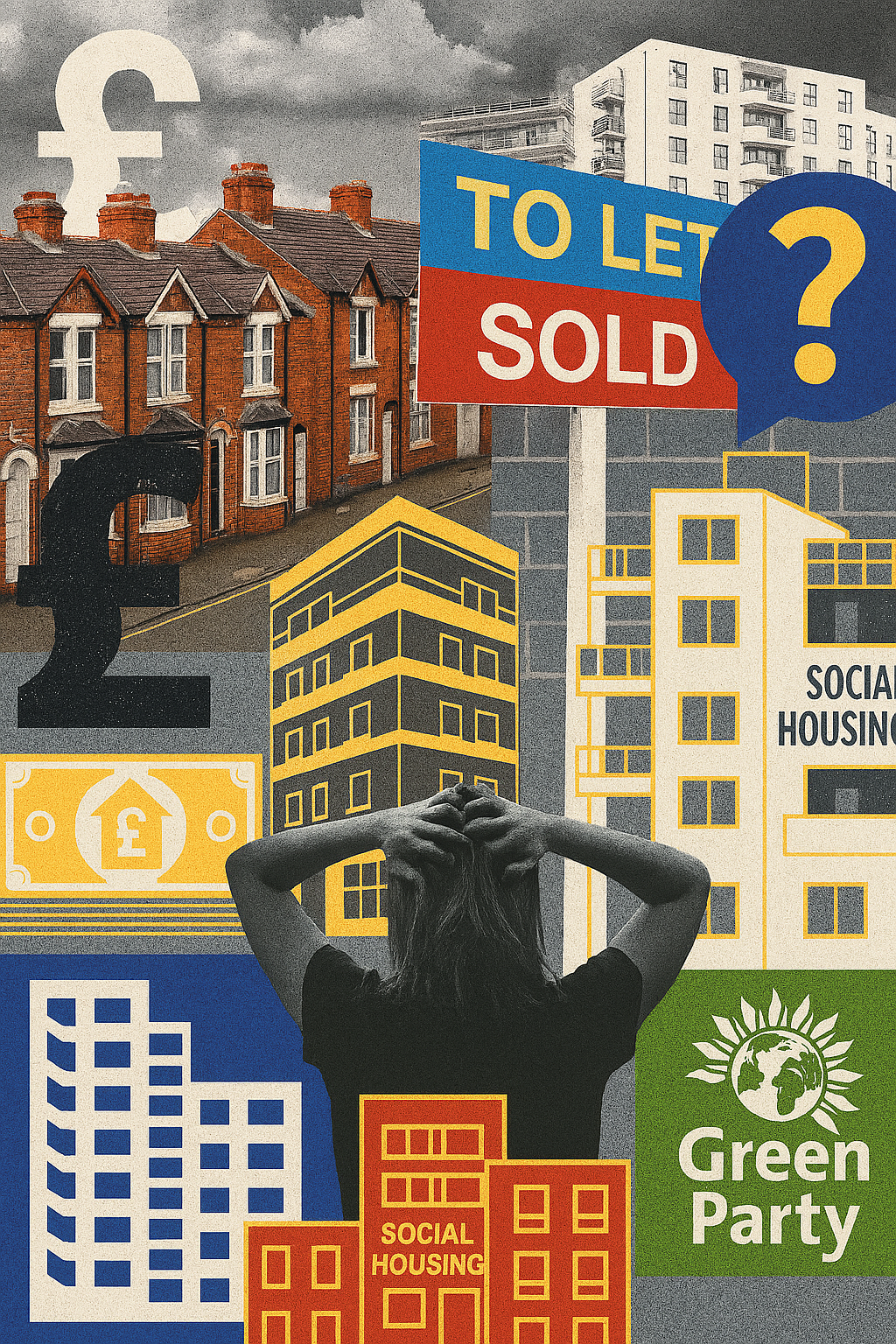
The British housing market, long a crucible of aspiration and anxiety, stands at a precipice. Decades of market-led policies have, paradoxically, created a landscape where secure, affordable housing feels increasingly out of reach for millions. Against this backdrop, the Green Party has tabled a proposal so audacious, so structurally transformative, that it demands rigorous scrutiny: a systematic dismantling of the private rental sector (PRS) and its replacement with vastly expanded social housing. This is not mere tinkering; it represents a fundamental challenge to the very notion of housing as a commodity, seeking instead to embed it as a public utility. The question, then, is not simply whether this vision is desirable, but whether it is, in the cold light of economic reality and political will, truly viable.
The Crisis: A Legacy of Depletion and Dislocation
To grasp the Greens’ radicalism, one must first confront the depth of the crisis. The prevailing narrative of housing shortage often obscures a more profound truth: a systemic depletion of public assets. Since 1980, the Right to Buy (RTB) policy has seen nearly a million more social homes sold than replaced – a vast, unacknowledged transfer of public wealth into private hands. The consequence is stark: an exponential growth of the PRS, where affordability and security have critically eroded. Today, the typical private tenant commits an average of 34% of their income to rent, rising to nearly 40% in London, a sharp contrast to the 10% average paid by council tenants in 1980. The irony is that an estimated 41% of RTB homes have re-entered the market as high-cost private rentals, completing a grim cycle of public divestment and private extraction. This is not simply a market failure; it is a structural wound demanding a structural cure.
The Green Mandate: De-Commodification as the Core Principle
The Green Party’s motion is unambiguous: to strategically reduce the private rental market while simultaneously expanding socially rented homes “over time.” This is a vision of “radical de-commodification,” aiming to wrest housing “from the landlords and speculators and the harsh imperatives of capital markets.” Their strategy is multifaceted, employing three primary levers: regulatory (strict rent controls, Section 21 abolition), fiscal (Land Value Tax, empty property tax, Business Rates for short-term lets, National Insurance on rental income), and financial (elimination of Buy-to-Let mortgages, tenant’s ‘Right to Buy’ with rent discount). This comprehensive package signals a complete philosophical pivot from market-led solutions to a state-centric, public asset model.
The Extractive Nature of Land: A Georgist Reckoning
At the heart of the Green Party’s rationale lies a classical economic understanding that frames the landlord-tenant relationship as “inherently and intrinsically extractive and exploitative.” This is not casual rhetoric, but a policy position rooted in Georgist economic theory. The premise is simple: land, a fixed commodity, derives its value not from its individual owner’s productive effort, but from population growth, communal infrastructure, and public spending. This “unearned increment” is currently capitalised into real estate prices, allowing owners to accrue speculative wealth without corresponding productive investment.
The Green policy, therefore, is a strategic manoeuvre to recapture this unearned increment. By framing the relationship as exploitative, the policy justifies shifting the tax burden onto this non-productive income via instruments like the Land Value Tax. Taxing this value reduces the speculative element in land pricing, freeing up capital for genuine productive investment. Furthermore, the insecurity of the PRS, epitomised by Section 21 evictions, is seen not just as a human cost, but as a market distortion contributing to affordable housing scarcity. The systematic erosion of council housing through RTB reinforces the structural need for a public alternative. Even within owner-occupation, “embedded management companies” demonstrate how land control can create anti-competitive and wealth-extractive structures, further validating the Greens’ focus on land itself.
The Policy Blueprint: Mechanisms for a New Compact
The Green Party’s blueprint for transition is a deliberate assault on the profitability and speculative appeal of residential property investment. Initial regulatory priorities are clear: immediate tenant protection and empowerment. Abolishing Section 21 evictions and implementing rent controls are intended to stabilise the environment for existing tenants during an anticipated tumultuous transition. Beyond stability, the policy proposes wealth transfer mechanisms, notably taxpayer-funded finance for tenants to exercise a ‘Right to Buy’ when a landlord sells, with previous rent payments discounted from the purchase price. This aims to facilitate a rapid transfer of existing PRS stock into owner-occupied tenure, reducing reliance solely on new state construction.
The fiscal strategy aims to fundamentally strip profitability and liquidity from property investment. Eliminating Buy-to-Let mortgages, coupled with National Insurance on private rental income, makes property leasing economically unattractive for investors. Furthermore, speculative land hoarding and under-utilisation are targeted through Business Rates on short-term lets and double taxation on empty properties. These measures are designed to force available units back into long-term residential supply.
Yet, the intellectual anchor, the foundational fiscal engine, is the proposed Land Value Tax (LVT). Economists widely regard LVT as an exceptionally efficient tax, levied solely on land value, disregarding improvements. Crucially, as land supply is fixed, LVT does not distort economic activity like taxes on labour. This efficiency is paramount. By taxing away land rents otherwise capitalised into property prices, LVT is expected to cause prices to fall, encouraging landowners to develop or sell underutilised plots. This consensus positions LVT as the mechanism to fund a housing revolution without additional economic drag, potentially mitigating distortionary effects of other regulatory measures like rent control. LVT offers a non-distortionary, progressive alternative, aligning precisely with shifting the tax burden toward wealth.
The Economic Case: LVT, Revenue, and the Vienna Blueprint
The success of such a transformative motion hinges on establishing a fiscally robust and structurally proven replacement. LVT, in theory, provides the necessary funding, enabling replication of successful state-led models, most notably Vienna’s housing system. LVT generates a predictable and stable revenue stream because land values represent a fixed, quantifiable asset. This stability is critical for funding long-term liabilities inherent in social housing provision, demanding cost assumptions extending 30 years or more.
LVT implementation aligns with broader tax reform goals, potentially allowing abolition of distortionary taxes like Stamp Duty Land Tax, boosting property transactions. If replacing the land component of Business Rates, it would encourage investment in structures. The Green Party explicitly aims for taxation devolution; LVT, as a local residential property tax, ensures local government becomes the main recipient, linking revenue directly to local housing needs. This local funding mechanism is vital for achieving the target of building approximately 125,000 new social homes annually.
Vienna provides the most compelling international blueprint for large-scale, de-commodified housing. Over 60% of its residents live in high-quality, controlled-rate apartments, owned by the city or subsidised non-profits. This system protects low-income residents and fosters a strong middle class. Affordability is achieved because this housing is permanently shielded from market price pressures. The essential success factor in Vienna is pre-emptive land de-commodification. The city’s Wohnfonds Wien acquires sufficient land for 15 years of anticipated residential development, with land prices for subsidised construction strictly limited by law. LVT, by reducing land capitalisation and forcing prices to fall, acts as the perfect enabling fiscal mechanism for the UK to establish a similar publicly-funded land procurement body, acquiring land at a controlled, non-speculative price, replicating Vienna’s core strength: removing land as the primary generator of speculative wealth before construction begins.
The Counter-Argument: Transitional Risks and Economic Friction
While the structural economic case for LVT and public ownership is compelling, the Green Party’s policy package introduces massive transitional friction, risking severe short-term instability. The aggressive combination of punitive taxes (NI on rental income, BTL elimination) and strict regulation (rent controls, Section 21 abolition) aims to expedite private capital withdrawal. However, this risks accelerating an uncontrolled landlord exodus. Data suggests this trend is underway, with over a quarter of landlords reportedly selling property last year. Landlord representatives argue further tax hikes will “dampen investment, undermine tenant choice and push rents even higher.” The primary danger is a rapid mismatch between private rental supply destruction and state replacement capacity. The UK market already faces intense demand, with 11 renters chasing every available home. Forcing a rapid PRS contraction, when new social housing completions stood at just 2,850 units in England last year, creates a temporary but severe vacuum. This would disproportionately harm the most vulnerable through hyper-inflation in remaining unregulated markets, irrespective of long-term structural benefits.
Furthermore, rent controls, while intended as an immediate tenant shield, carry significant long-term risks documented by economic research. Studies examining strict rent caps (e.g., Cambridge, MA, 1970–1994) showed that while controlled units rented 40% below market rates, long-run consequences included decreased overall affordability, reduced housing stock, decreased investment, and increased gentrification in surrounding areas. The policy must navigate this tension: political necessity of immediate tenant protection clashes directly with empirical evidence that price caps, without robust public supply increases, ultimately distort the market and decrease housing quality and quantity.
Scaling up house building to 125,000+ social homes per year requires extraordinary state and local authority capacity. Registered providers must comply with strict governance and financial viability standards. Reliance on Modern Methods of Construction (MMC) introduces financial and operational risks, including manufacturer insolvency and proprietary techniques making replacement difficult. Registered Providers need 30+ year cost assumptions for viability, difficult given MMC’s nascent state. A final risk involves state provision. Critics warn state landlordism may be “regressive” if high monthly payments act as a significant “housing tax on low income people.” This underlines the critical distinction between state management and true social housing; the UK model must adopt Vienna’s approach, funded to offer deeply subsidised, permanently affordable tenure, ensuring state revenue doesn’t force housing costs back towards market rates.
Synthesis and Balanced Conclusion
The Green Party’s proposal presents a stark choice: accept the structural economic inefficiencies and social injustices of the status quo, or embrace a transformative, high-risk transition toward a de-commodified system. The Green policies are, in essence, economically contradictory, resting on the highly efficient, wealth-focused LVT and politically necessary, yet empirically distortionary, measures like strict rent control. Long-term efficacy hinges entirely on LVT’s capability to deliver two synchronised outcomes: rapidly reducing land prices and generating sufficient, stable revenue to finance state land acquisition and construction. This fiscal engine must operate at a scale and speed that offsets the negative supply shock generated by aggressive regulatory tools.
Beyond economics, the transition is fundamentally a political challenge. LVT implementation, despite its theoretical efficiency and centuries of economic endorsement, has consistently been thwarted by political resistance. Landowners often possess significant political influence, explaining its limited global spread. Historically, UK attempts to introduce significant land taxes met determined opposition from vested interests. Therefore, successful implementation requires “bold and decisive” political will.
The analysis concludes the Green policy framework is structurally superior to the current market-driven system. It targets foundational economic inefficiency of land speculation through LVT and establishes a proven, scalable alternative tenure model based on Vienna. However, viability critically depends on the state’s ability to operationalise LVT and scale up construction capacity immediately. Without exceptional state capacity to manage the simultaneous closure of the PRS and creation of the social housing sector, transitional friction will dominate, potentially leading to widespread homelessness and economic crisis.
Strategic Decision and Justification: A Mandate for De-Commodification
Based on a rigorous comparison of the current system’s guaranteed failure – perpetual scarcity, inequality, and unearned extraction – against the managed risks of the proposed structural reform, the decision is affirmed in favour of the Green Party’s vision. The current policy environment ensures continued capitalisation of unearned land rent, perpetually undermining productivity and equity. The proposed alternative offers a necessary, evidence-based economic pathway toward a stable, efficient, and equitable housing compact.
The LVT, as the most economically efficient and progressive tax available, provides a sustainable mechanism to fund the necessary public investment. Its function in de-capitalising land prices is indispensable for replicating Vienna’s success, where controlling land cost is paramount for permanent affordability. The long-term benefits of permanent de-commodified tenure outweigh the severe but manageable transitional risks, provided mitigation strategies are executed with precision.
The transition must not be executed simultaneously, but in strategically phased steps that prioritise creating replacement fiscal and land acquisition infrastructure before the full punitive weight of regulation falls on the PRS.
Phase I: Fiscal and Land Acquisition Focus. Prioritise LVT implementation and simultaneous establishment of a dedicated, large-scale Land Procurement Fund (replicating Vienna’s Wohnfonds Wien). This land bank must be established and capitalised before aggressive PRS measures (BTL elimination, NI tax hikes) are fully enacted. This sequence ensures the state stabilises critical housing input cost (land) and establishes non-speculative land supply, minimising upward pressure on construction costs.
Phase II: Building and Stock Transfer. Aggressively scale up house building capacity, potentially via guaranteed demand and long-term contracts for modular construction providers, mitigating MMC insolvency/viability risks. Concurrently, prioritise financial resources for transferring existing PRS units into owner-occupied or social tenure via taxpayer-funded tenant acquisition. This immediate stock transfer bridges the vast gap between current state capacity (2,850 units/year) and required scale (125,000+ units/year).
Phase III: Regulatory Management.Strict rent controls must be managed carefully. Their introduction should couple with targeted state acquisition subsidies to incentivise landlords to transfer units directly into the subsidised social sector, rather than simply selling or allowing deterioration. Regulatory measures must serve as temporary mechanisms for tenant instability during building, not as a permanent housing solution.
The Green Party’s ‘Abolish Landlords’ motion is a necessary, albeit complex, economic strategy aimed at ending the capitalisation of communal land rent. Success hinges on transforming housing from a financial commodity back into essential public provision, possible only through robust LVT deployment and adopting Vienna’s principles of de-commodified land management. This is the only clear path to permanently resolving the UK’s housing affordability and security crisis.