
Prologue: October 1956
On a grey autumn morning in 1956, British troops withdrew from the Suez Canal. In the House of Commons, Prime Minister Anthony Eden faced a furious Parliament. In Cairo, Egyptian crowds celebrated. In Washington, President Eisenhower allowed himself a satisfied smile. The British Empire, it seemed, was well and truly dead.
But in a series of oak-panelled rooms in the City of London, a different conversation was taking place. The men gathered there bankers, mostly, with a few Treasury officials weren’t mourning the empire’s end. They were sketching out its replacement.
What they designed that winter would prove more profitable, more powerful, and far more enduring than anything their Victorian predecessors could have imagined. It would claim no territory, plant no flags, and appear on no maps. Instead, it would weave an invisible web of financial secrecy that would, over the following decades, become the most sophisticated wealth extraction mechanism the world has ever known.
Today, an estimated £21 trillion nearly a third of the world’s wealth sits in offshore tax havens, with Britain’s network handling the lion’s share.[^1] Developing countries alone lose an estimated £100 billion annually to tax avoidance facilitated by these structures.[^2] Britain itself forgoes tens of billions each year from wealthy individuals and corporations exploiting the very system it created.
This is the story of how one empire died and another, far more insidious, rose from its ashes.
Act One: The Gentleman’s Agreement
The crisis came swiftly. Within weeks of the Suez humiliation, the pound sterling came under devastating attack. Currency traders, sensing weakness, began selling British pounds in massive volumes. The Bank of England’s foreign reserves drained at an alarming rate. Britain faced a choice: accept International Monetary Fund conditions that would effectively acknowledge its diminished status or find another way.
The Governor of the Bank of England, a precise man named Cameron Cobbold, made a series of telephone calls. The conversations that followed between the Bank and the City’s merchant banks would reshape the global economy, though the participants could hardly have known it at the time.
The solution they devised was elegant in its simplicity, revolutionary in its implications. If City banks conducted transactions between non-British parties in foreign currencies particularly American dollars these activities would exist in a regulatory twilight zone, neither fully British nor fully foreign. Money could flow through London whilst being, for legal and tax purposes, absolutely nowhere at all. [^3]
This legal fiction the “Eurodollar market” was an instant sensation. [^4] American banks discovered they could operate in London whilst sidestepping their own country’s tiresome regulations and tax requirements. By 1960, there were several billion dollars in this phantom market. By 1970, over $100 billion. By 1980, over a trillion.
What had been the financial capital of a fading empire transformed overnight into the world’s first truly offshore financial centre. Britain could no longer rule the waves, but it would rule the flows of global capital. And in doing so, it would help that capital escape taxation wherever it originated.
Act Two: The Colonial Remnants Find Their Purpose
In 1967, a lawyer named Michael Riegels flew from London to the Cayman Islands on what seemed a routine corporate matter. What he found was a cluster of Caribbean islands where mosquitoes were so thick they could suffocate livestock, where the population barely reached 10,000, and where the main industry was turtle farming.
What Riegels saw, however, was potential.
The Cayman Islands, like dozens of other scattered fragments of Britain’s colonial past, remained under British legal influence whilst being technically separate. This created what tax lawyers would come to call “the perfect jurisdictional architecture.” These territories could offer their own tax laws or rather, the absence of tax laws whilst clients enjoyed the protection and legitimacy of British courts.
Within a decade, the transformation was remarkable. The Caymans, the British Virgin Islands, Jersey, Bermuda all discovered their true calling. They would become what Britain itself could not openly be: tax havens operating under the protection of British law. [^5]
By the early 21st century, the Cayman Islands, with barely 65,000 residents, would be home to more than 100,000 registered companies and serve as the booking location for over $2 trillion in assets. [^6] It levies no income tax, no corporation tax, no capital gains tax, no inheritance tax. For tax purposes, wealth that passes through the Caymans simply evaporates.
Act Three: The Industrial Revolution of Tax Avoidance
On the morning of 3 April 2016, a group of journalists at the German newspaper Süddeutsche Zeitung began publishing what would become the Panama Papers. The 11.5 million documents leaked from the Panamanian law firm Mossack Fonseca would illuminate not just individual acts of corruption but an entire parallel universe of tax avoidance. [^8]
The documents revealed that Mossack Fonseca had created more than 240,000 shell companies for 14,000 clients. [^9] But what stunned investigators wasn’t just the scale it was the sheer ordinariness of it all. This wasn’t some rogue operation. This was industrial-scale tax avoidance, and Mossack Fonseca was just one firm among hundreds providing the same service.
The Tools of Disappearance
The shell company proved to be the workhorse of this new industry. These entities exist purely on paper no employees, no offices, no actual operations yet they’re devastatingly effective. The mechanism is simple: a company registers in a zero-tax jurisdiction like the British Virgin Islands, then becomes the legal owner of assets and recipient of income. Because the BVI levies no corporate tax, the income simply isn’t taxed. [^7]
But the real sophistication came with the British trust, a medieval legal device that tax lawyers had weaponised. When the Panama Papers revealed the trust structures created for the ultra-wealthy, the complexity was staggering. Assets would be placed in a trust in Jersey, which would own shell companies in the British Virgin Islands, which would hold bank accounts in the Caymans and investments worldwide. The income from these investments would flow through this structure, taxed nowhere, belonging legally to no one. [^10]
The Professionals
Behind every complex structure stood an army of enablers. Britain’s Big Four accounting firms Deloitte, PwC, EY, and KPMG had built entire divisions dedicated to what they euphemistically called “tax planning.”[^11] These weren’t isolated transactions; these firms operated like factories, mass-producing tax avoidance schemes.
In 2014, leaked documents revealed that PwC had been securing secret tax rulings from Luxembourg authorities, allowing clients to reduce their effective tax rates to 1% or less. [^12] The firm had turned tax avoidance into a product line, selling the same schemes to hundreds of multinational clients.
When HSBC’s Swiss banking arm was exposed in 2015, the documents showed systematic assistance in tax evasion, with the bank allegedly holding £78 billion in assets for clients seeking to avoid tax. [^13] One internal email casually discussed helping clients structure their affairs to avoid “tax inefficiencies” which is rather like calling robbery “unauthorised asset redistribution.”
Act Four: Following the Money
To understand how this system actually works, follow a single pound as it travels through the offshore architecture.
The Amazon Route
A British customer orders a book from Amazon.co.uk. They pay £20. Where does that money go?
For years, that £20 didn’t go to Amazon UK Limited. It went to Amazon EU Sarl, a Luxembourg company. Amazon had structured its European operations so that all UK sales were technically made by this Luxembourg subsidiary. The profits from British customers thus flowed to Luxembourg, which offered extraordinarily generous tax arrangements to multinationals. [^22]
In years when Amazon generated billions in UK revenue, it paid as little as £15 million in UK corporation tax an effective rate well under 1%. The profits didn’t disappear; they simply appeared in Luxembourg, where secret arrangements meant they were barely taxed either.
The Starbucks Method
In 2012, Reuters revealed that Starbucks had paid no UK corporation tax despite generating over £400 million in annual revenue. [^23] The mechanism was brutally efficient.
Starbucks UK paid substantial “royalty” fees to a Dutch subsidiary for the right to use the Starbucks brand and recipes. It also paid inflated prices for coffee beans to a Swiss trading subsidiary. These payments all internal corporate transfers reduced UK profits to levels so minimal that no tax was due.
The coffee didn’t get more expensive. The intellectual property didn’t change. The payments simply moved profits from the UK to jurisdictions with lower tax rates. It was accounting alchemy, turning taxable income into tax-free transfers.
The Individual: A Case Study in Complexity
When Lewis Hamilton purchased a private jet in 2013, he didn’t buy it directly. Instead, the £16.5 million aircraft was acquired through a complex structure involving a trust and companies in British tax havens, allowing him to reclaim £3.3 million in VAT.[^21] Tax authorities challenged the arrangement, and the courts eventually found against him, but the case illustrated something important: the extraordinary lengths to which the wealthy go and the tools Britain’s offshore network provides to minimise tax.
Consider a more typical case: a wealthy individual places assets into an offshore trust in Jersey. The trust is technically the owner, so the individual avoids capital gains tax when shares are eventually sold. The trust sells the shares and accumulates millions in cash, all tax-free because it’s resident in a zero-tax jurisdiction.
Then comes the elegant part. Rather than distributing this money (which would trigger income tax), the trust lends it to the individual. Loans aren’t taxable income. [^20] The individual thus receives millions in cash, completely tax-free, to fund their lifestyle. The loan might have a 100-year term, or be rolled over perpetually, or simply be forgiven after death. The wealth is accessed and enjoyed without ever being taxed.
Act Five: The Victims
London, 2024
Sarah Mitchell teaches at a primary school in Hackney. Her salary is £42,000 a year. After income tax and National Insurance, she takes home about £32,000. She rents a one-bedroom flat for £1,600 a month because buying in London is, as she puts it, “a fantasy for people like me.”
Three miles away, in Knightsbridge, a luxury apartment sits empty. It’s owned by a British Virgin Islands company, which is itself owned by a trust in Jersey. The true beneficial owner lives in another country entirely and visits London perhaps twice a year. When the property was sold last year for £15 million a £6 million gain no capital gains tax was paid. The offshore structure ensured that, legally, no taxable event occurred. [^32]
Sarah pays 24% of her income in tax. The apartment’s owner paid nothing on a £6 million gain. This isn’t a glitch in the system. This is the system working as designed.
Over £4 billion of London property is held through offshore companies, predominantly registered in British Virgin Islands and other UK-linked tax havens.[^33] The average London house now costs over 12 times average earnings.[^34] Young people face home ownership as an impossible dream, whilst offshore money fleeing tax authorities worldwide continues to flood into London property, pushing prices beyond what domestic incomes can sustain.
Zambia, 2018
In the Copperbelt Province of Zambia, massive trucks haul copper ore from open-pit mines. The copper Zambia’s primary resource is extracted by multinational mining companies. But through a web of transfer pricing arrangements, the actual profits from this extraction appear not in Zambia but in Swiss trading subsidiaries and tax haven intermediaries.
In years when international copper prices soared, Zambian mining operations reported minimal profits whilst billions appeared in offshore entities. The missing tax revenue would have transformed one of Africa’s poorest nations. Instead, it sits in accounts in jurisdictions within Britain’s offshore network. [^38]
This pattern repeats across Africa. Nigeria loses oil revenues to offshore structures. The Democratic Republic of Congo sees cobalt profits vanish. Ghana loses gold revenue. [^40] In each case, multinational corporations often British or using British offshore structures extract resources whilst avoiding tax. Africa loses an estimated £50 billion annually to illicit financial flows, much of it through tax avoidance. [^39] That’s more than three times the total international aid the continent receives.
Britain Itself
Perhaps the cruellest irony is that Britain has become a victim of its own creation. HMRC estimates the UK loses approximately £35 billion annually to tax avoidance, evasion, and non-payment, though tax justice campaigners argue the true figure exceeds £100 billion. [^28]
To understand what £35 billion represents: it’s more than the entire annual budget of the Metropolitan Police, UK Fire and Rescue Services, and the Prison Service combined. [^29] It’s nearly double what’s spent on universities. It’s 4% of total government revenue simply vanishing into offshore structures that Britain itself created.
And the symbolism? HMRC’s headquarters the very institution responsible for collecting Britain’s taxes is owned through an offshore structure in Bermuda designed to avoid UK tax. [^35] The building represents a perfect metaphor: the British state, specifically the department responsible for collecting tax, is a tenant of tax avoiders.
Act Six: The Debate
In a committee room in Westminster, a debate is taking place about solutions. The proposals on the table reflect fundamentally different understandings of the problem.
The Wealth Tax Proposal
Labour MP Margaret Hodge presents the case for a wealth tax. “A 1% annual levy on assets exceeding £10 million could raise £10-20 billion annually,” she argues. [^42] “When a nurse pays 40% on wages whilst a billionaire pays 20% on capital gains, something is fundamentally broken.”
The argument has moral force. But across the table, a Conservative treasury minister raises the spectre of France, where over 10,000 wealthy individuals departed within a decade of introducing a wealth tax, taking an estimated €35 billion with them. [^43] “In 1990, twelve OECD countries operated wealth taxes,” he notes. “By 2020, only four remained. The others abandoned them because they proved administratively complex, easy to avoid, and raised far less than projected.”[^44]
The debate circles. Much wealth exists in forms difficult to value: private company shares, art collections, intellectual property. Swedish wealth tax returns showed systematic undervaluation of private shares, often by 50-80%. [^45] The exemptions required to make a wealth tax workable would gut its revenue potential.
The Structural Reform Alternative
From the back benches, another voice. “We’re debating tax rates whilst the wealthy have opted out of taxation entirely. The problem isn’t the tax system it’s the offshore architecture that allows tax to disappear.”
This camp advocates structural dismantling: public beneficial ownership registries for all entities in British territories, genuine automatic information exchange between tax authorities, country-by-country financial reporting by multinationals. [^46] Equalise capital gains rates with income tax rates this alone could raise £20-30 billion annually whilst eliminating the primary incentive for offshore structures.[^50]
The proposal has technical merit. But the City of London employs hundreds of thousands. The Big Four accounting firms, elite law firms, and major banks all profit handsomely from facilitating tax avoidance. Any threat triggers lobbying campaigns of extraordinary intensity.[^47] And many MPs have personal stakes in maintaining the current system their own tax returns reveal complex offshore structures.
Epilogue: The Choice
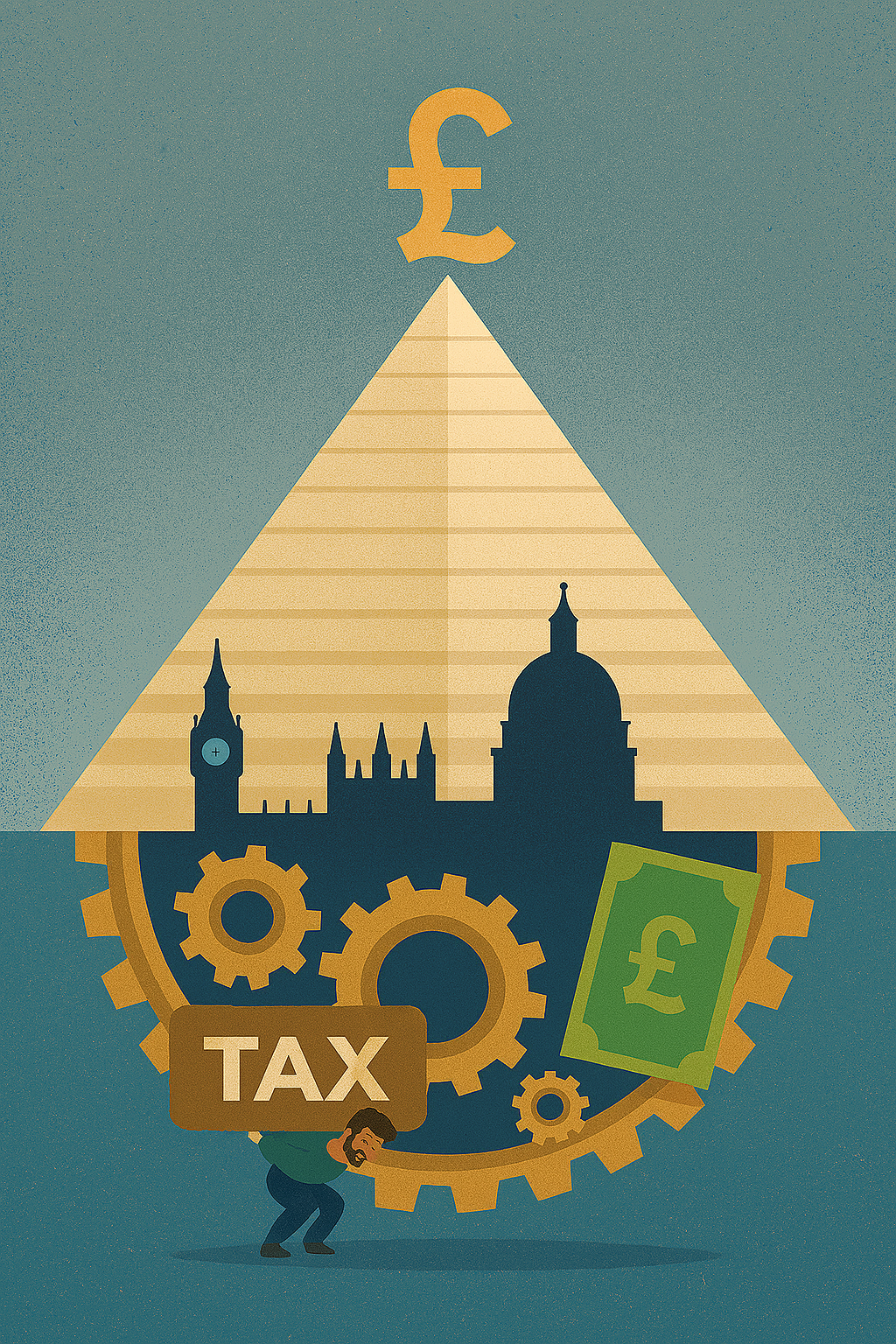
Seven decades after Suez, Britain faces a choice that its financial elite made in 1956 but which has never been truly democratically decided: who gets to hold the steering wheel of the economy?
For those seven decades, that wheel has been held by the interests of global capital and the City of London. The result is visible in every hollowed-out industrial town, every generation locked out of home ownership, every starved public service, and every developing nation stripped of resources through offshore structures.[^49]
The system was created by political choices, and political choices can unmake it. The Eurodollar market emerged from conversations between the Bank of England and City banks a policy decision, not economic inevitability.[^3] The transformation of colonial remnants into tax havens required deliberate government action.[^5] Every element of the offshore architecture is the product of decisions by people in power.
But the barriers are formidable. The City’s lobbying power is immense. Wealthy individuals including politicians have personal stakes in the current system. International coordination faces collective action problems: every nation wants others to crack down whilst keeping its own havens competitive.
The invisible empire has reigned for seven decades. Its consequences are visible in Sarah Mitchell’s expensive rented flat and empty Knightsbridge apartments held offshore. They’re visible in Zambian copper mines and missing African tax revenues. They’re visible in Britain’s starved public services and accelerating inequality.
The technical means of reform exist: public ownership registries, automatic information exchange, tax equalisation, minimum standards for British territories. The question isn’t technical it’s political. Either Britain reclaims the steering wheel from offshore capital, or it continues its descent into a two-tier society where the wealthy inhabit a parallel economy, enjoying British stability whilst declining British obligations.
The wheel is there to be grasped. The question is: does anyone have the political courage to grasp it?
References
[^1]: Tax Justice Network estimates of global offshore wealth [^2]: Tax Justice Network, “The State of Tax Justice 2024” – estimates of developing country tax losses [^3]: Academic research on the historical development of the London Eurodollar market following the 1956 Suez Crisis [^4]: Studies of the Eurodollar market’s evolution into a tax avoidance mechanism [^5]: Historical research on the Cayman Islands’ transformation from colonial backwater to financial centre [^6]: Studies of British Overseas Territories and Crown Dependencies as tax havens, particularly the Cayman Islands [^7]: Analysis of shell companies as instruments of tax avoidance, drawing from Panama Papers research [^8]: International Consortium of Investigative Journalists, “Panama Papers” (2016) [^9]: Panama Papers data on Mossack Fonseca’s operations [^10]: Academic research characterising British trust structures as primary tax avoidance mechanisms [^11]: Research on the role of Big Four accounting firms in industrialising tax avoidance [^12]: Studies of systematic tax avoidance scheme development by professional services firms [^13]: Investigation into HSBC Swiss banking arm’s tax evasion facilitation [^20]: Research on loan-back schemes and personal tax avoidance strategies [^21]: Analysis of Lewis Hamilton’s jet purchase VAT case [^22]: Amazon UK tax avoidance case studies and effective tax rate analysis [^23]: Starbucks UK tax avoidance documentation [^28]: HMRC estimates of the UK tax gap; Tax Justice Network alternative estimates [^29]: UK public spending data for comparative context [^32]: Investigations into offshore property ownership in London [^33]: Studies of empty luxury developments owned through offshore structures [^34]: UK housing affordability data and house price to earnings ratios [^35]: Investigation into HMRC headquarters ownership through Mapeley STEPS (Bermuda) [^38]: Case studies of Zambian copper mining tax avoidance [^39]: Research on illicit financial flows from Africa [^40]: Studies of resource extraction tax avoidance in Nigeria, DRC, and Ghana [^42]: Academic research on wealth tax proposals, including revenue estimates [^43]: Studies of capital flight in response to wealth taxes – French experience [^44]: Historical analysis of wealth taxes in OECD countries and reasons for abandonment [^45]: Research on asset valuation problems in wealth tax implementation – Swedish case [^46]: Studies of alternative reform approaches including tax rate equalisation [^47]: Research on City of London lobbying and financial services industry political influence [^49]: Analysis of offshore structures’ role in developing nation resource extraction [^50]: Revenue estimates from capital gains tax rate equalisation proposals